


The northern lights are the only major attraction on earth that nobody can guarantee. There is no schedule, no ticket office and no honest operator who will promise you the show. What exists is probability — and probability is built from three things: latitude, number of nights and clear sky. That is why a seven-day expedition in Swedish Lapland has completely different odds from a weekend in any Nordic capital.
This guide explains how aurora hunting actually works, what you do on the nights the sky closes in, what -25 °C really feels like, and how a week in Kiruna is structured.
Why Kiruna, and not somewhere else
Kiruna sits above the Arctic Circle, inside what scientists call the auroral oval — the band around the magnetic pole where the aurora appears most often. Being inside that band changes everything: further south you need a strong solar storm to see anything, while inside it even modest solar activity produces visible aurora.
The second advantage is climate. Inland Swedish Lapland is drier than the Norwegian coast, and dry air means clear sky — the factor that ruins aurora nights is rarely low solar activity, it is cloud. The third is logistics: Kiruna has an airport, established winter infrastructure and quick access to areas with no light pollution at all.
How aurora hunting works
The aurora happens when charged particles from the solar wind meet the Earth’s magnetic field and excite gases high in the atmosphere. Green comes from oxygen; the rarer reds and violets appear during stronger episodes. In practice, three variables decide your night:
- Solar activity — measured by the Kp index, 0 to 9. Inside the auroral oval, Kp 2 or 3 already produces visible aurora.
- Clear sky — the decisive and least predictable factor. This is why expeditions move: if one valley is clouded over, you drive to another.
- Darkness — no twilight and little moon. A full moon washes out the weaker colours.
The maths that matters: on any single night in Kiruna during the season, your chances are good but far from certain. Across six consecutive nights, the probability of at least one strong display becomes very high — which is exactly why week-long expeditions exist instead of two-day packages.
Best time to see the northern lights
The season runs September to March, because that is when nights are long and dark. But the months are not equivalent:
| Period | Dark nights | Cold | Snow for activities |
|---|---|---|---|
| September–October | Good | Mild | Little or none |
| November–December | Very long | Severe | Building up |
| January–February | Long | Coldest | Complete |
| March | Good | Less severe | Complete |
February and March are the best combination: nights dark enough, snow consolidated for snowmobiles and sleds, and enough daylight for the activities. That is the window ROXMOTORS Arctic expeditions operate in.
What a seven-day Arctic expedition looks like
The logic of a good Arctic itinerary is simple: days are for activities, nights are for the aurora. Each day delivers a complete experience on its own, and the aurora comes as the reward for being in the right place long enough. This is how the Aurora Artic Experience in Kiruna is built:
- Day 1 — arrival in Kiruna. Private transfer, welcome dinner and, if the sky is clear, the first aurora hunt that same night.
- Day 2 — husky sledding. You drive your own sled, in pairs, for around five hours on forest trails, with a hot lunch out in the open.
- Day 3 — Sami culture and reindeer. A visit to a reindeer farm and an immersion in the culture of the Sami, the original inhabitants of Lapland. At night, a snowmobile aurora hunt.
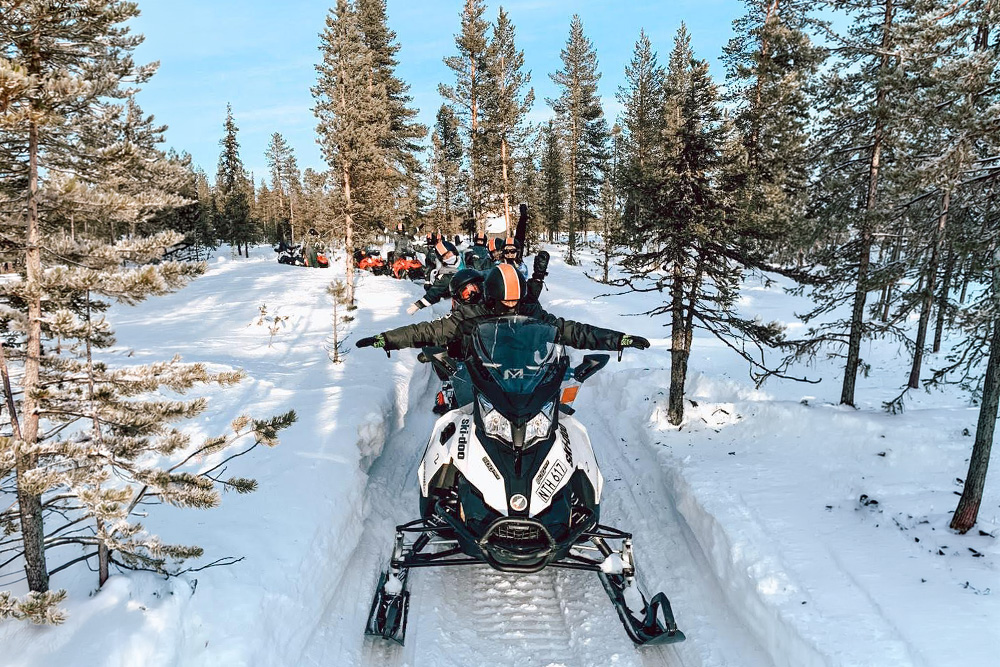
- Day 4 — snowmobile expedition. The most intense day: frozen rivers, dense forest and remote country, with every participant taking turns riding.
- Day 5 — snowshoes, ice fishing and the Icehotel. A walk to a frozen lake, lunch served on the ice, and an afternoon visit to the Icehotel.
- Day 6 — Kiruna mine and the last hunt. The largest underground mine in the world in the morning, Sweden’s largest husky kennel in the afternoon, and another night ride out.
- Day 7 — Kiruna and departure. The town, its famous wooden church and the airport transfer.
Note the design: four nights of active aurora hunting, and no day that depends on the aurora alone. An itinerary that treats the lights as its only attraction is one that can send you home empty-handed.
Snowmobiles: riding across a frozen river
For anyone coming from motorcycles, a snowmobile is a curious translation. The stance is familiar and the weight transfer is familiar, but grip works the opposite way from what intuition asks: the machine floats and slides on purpose, and control comes from your body rather than the bars. No previous experience is needed — the first hours are adaptation, and instruction is given on site.
Riding across a frozen river is the part nobody forgets. The surface is smooth, the horizon is white and any sense of scale disappears — no tree or building for reference, only open space and engine noise.
Husky sledding: you drive, you are not a passenger
There are two ways to do husky sledding: sitting in a cart behind a guide, or standing on the runners driving your own team. The second is a physical activity, demands attention in the corners and teaches you quickly that the dogs want to run more than you want to brake. Five hours of driving is enough to get past the initial nerves and actually understand the animals’ rhythm.
Sami culture: the part that gives the rest context
The Sami are the indigenous people of Lapland, with a culture built around reindeer herding in one of the harshest environments on the planet. A day with them changes how you read the landscape: what looked like white emptiness becomes territory with names, routes and history.
The Icehotel: sleeping there is optional, seeing it is not
The Icehotel in Jukkasjärvi is rebuilt every winter from ice taken out of the Torne River, and melts away in spring. Its suites are carved by invited artists from several countries, and every season brings a different set of works. It is worth the visit even if you have no intention of spending the night — and most itineraries treat it as a visit rather than accommodation.
The cold: what -25 °C actually means
The number frightens more than the experience. With the right clothing and no wind, -25 °C is perfectly tolerable for hours. What defeats people is three mistakes: cotton against the skin, unprotected extremities and standing still. The rules that work:
- Layers, never one thick garment. Merino or synthetic base layer, insulating mid layer (fleece or down), windproof and waterproof shell.
- No cotton. It absorbs sweat and freezes with you in it.
- Extremities first. Two-layer gloves, thermal socks, boots with room to spare (a tight foot is a cold foot), a hat that covers your ears, and a balaclava.
- Keep batteries and cameras inside your jacket. Cold kills phone batteries in minutes.
- On expeditions the full thermal kit is provided — an Arctic oversuit, boots and heavy gloves are not worth buying for one trip.
Do you need experience for this trip?
No. Not with motorcycles, not with snow, not with cold. That is the point most people miss before they ask: an Arctic expedition is not a technical test, it is an immersion trip with guided activities. Someone who has never seen snow completes the whole itinerary — the learning curve for a snowmobile or a sled is hours, not seasons.
How to photograph the aurora
A modern phone in night mode already records an average display. For something better, the essential item is a tripod — there is no hand-held aurora photograph. A starting point on a manual camera:
- Manual focus at infinity, set in daylight or on a bright star.
- Widest aperture available (f/2.8 or faster).
- ISO between 1600 and 3200, adjusted to your camera’s noise.
- Exposure of 2 to 10 seconds: the faster the aurora moves, the shorter it must be.
- Spare batteries in an inside pocket, and patience: the best displays last only minutes.
Frequently asked questions
Is seeing the northern lights guaranteed?
No, and be sceptical of anyone who guarantees it. What you can do is maximise probability: be inside the auroral oval, stay several nights and have the mobility to drive away from cloud. A seven-day itinerary with four active hunting nights puts your odds in a very different place from a short trip.
Do I need snowmobile or sledding experience?
No. Instruction is given on site and adaptation takes a few hours. Activities run at group pace, with guides.
When is the best time to see the aurora in Sweden?
Between September and March. February and March combine dark nights with consolidated snow for the activities — the best window for a complete itinerary.
How cold is it, and can I bring someone who dislikes the cold?
It is genuinely cold, between -10 °C and -30 °C. With the correct thermal equipment — which the expedition provides — it is comfortable even for people who have never faced that climate. The mistake is improvising with ordinary winter clothing.
Can I bring a non-riding companion?
Yes. Unlike a motorcycle tour, nothing here requires riding skill: sleds and snowmobiles are handled in pairs or in turns, and every activity works for companions.
The 2027 dates
The Aurora Artic Experience 2027 has four departures, and three of them — 31 January to 6 February, 7 to 13 February and 14 to 20 February — are already sold out. What remains is 21 to 27 February 2027. For more days on snow there is also the Arctic Snowmobile Safari, 28 February to 8 March, crossing Sweden, Finland and Norway. All dates are on the experience calendar.
If your interest is Scandinavia without snow, the motorcycle route runs in July: the Scandinavia tour covers Germany, Denmark, Norway and Sweden in 14 days.