

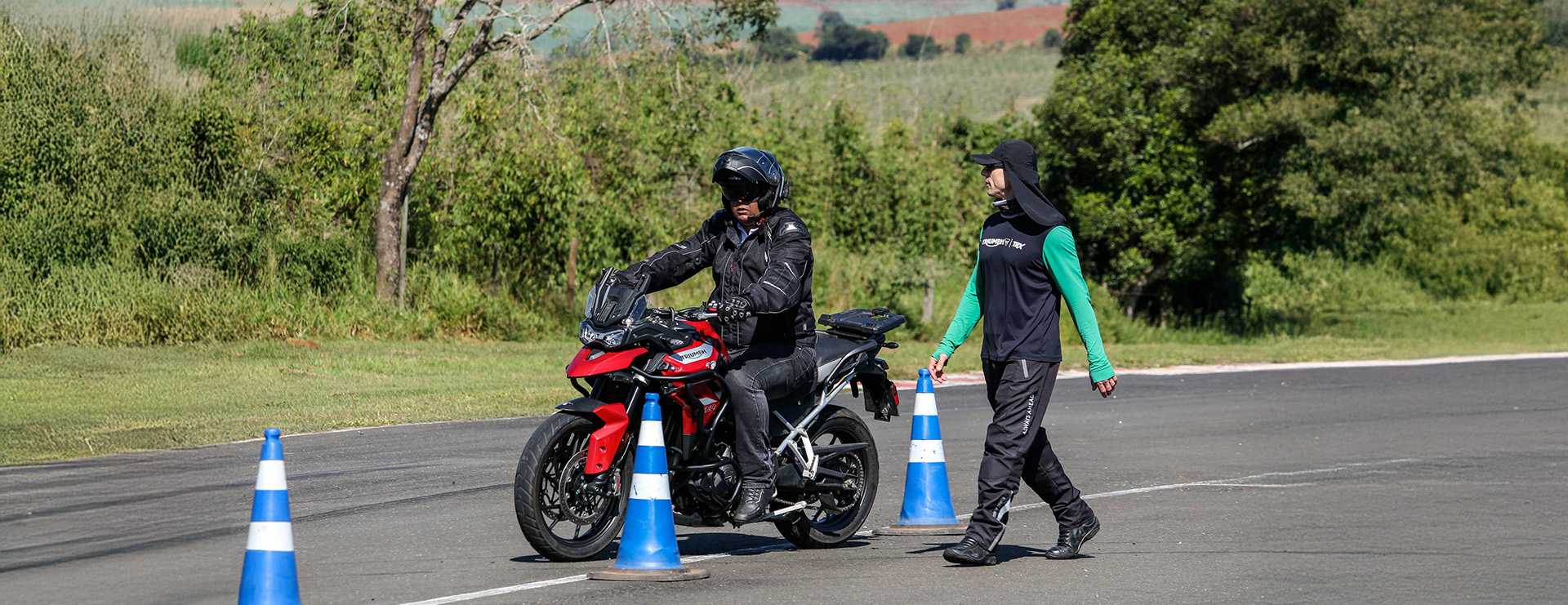
It happens far more often than you’d think.
After all, riding a motorcycle “fast” isn’t the hard part. The real challenge is riding slowly, manoeuvring, and having full control of the bike at low speed.
For shorter riders, on tall bikes or uneven ground, the challenge is even greater. And there’s only one way to avoid a drop: technique and practice.
So let’s get to work. Time for the theory behind the technique!
To handle low-speed manoeuvres, we need a familiarity and command of the bike that time in the saddle alone doesn’t necessarily give you. There’s no point saying you’ve been riding for 30 years if you do exactly the same thing every day.
Especially for those who only ride at weekends and on the open road — when it comes time to stop and manoeuvre, well… it’s every rider for himself.
To ride slowly, you have to work on what we call the “tug of war”: finding the harmony between the throttle, the clutch and the rear brake.
The motorcycle needs to be constantly “pushing”, with the throttle open at around 2,000 to 3,000 rpm and the clutch slightly released, much like holding the bike on a hill.
To “hold back” the speed, we use the rear brake. In other words, the released clutch makes the bike want to move and the rear brake makes it want to stop. There you have it: the principle of the tug of war.
What shouldn’t you do? Don’t squeeze the clutch in, because you lose one of the forces — and don’t release it too far either, straining it and forcing you to lean heavily on the rear brake. The secret is balance: smooth, measured, no sudden inputs.
If one of the forces is missing, the bike falls. If there’s too much, you wear out the drivetrain and can still fall. If the engine stalls, you fall… In short, balance is the recipe. And that takes practice and sensitivity.
All of this has to be combined with looking in the right place — fixing your eyes on your target — and with a proper riding position, to reduce your turning circle and avoid “fighting” the bike. It isn’t easy. Which is exactly why you should come and learn with us in practice!
In our On-Road 1 and On-Road 2 courses we cover manoeuvring technique in both theory and practice. And to become truly unbeatable, take our “Low-Speed Manoeuvring and Control” clinic after On-Road 2. We work on this technique specifically, with 8 different exercises.
Find out more on our courses page here on the website, or get in touch with our team! We’ll definitely help you ride better and more safely.