


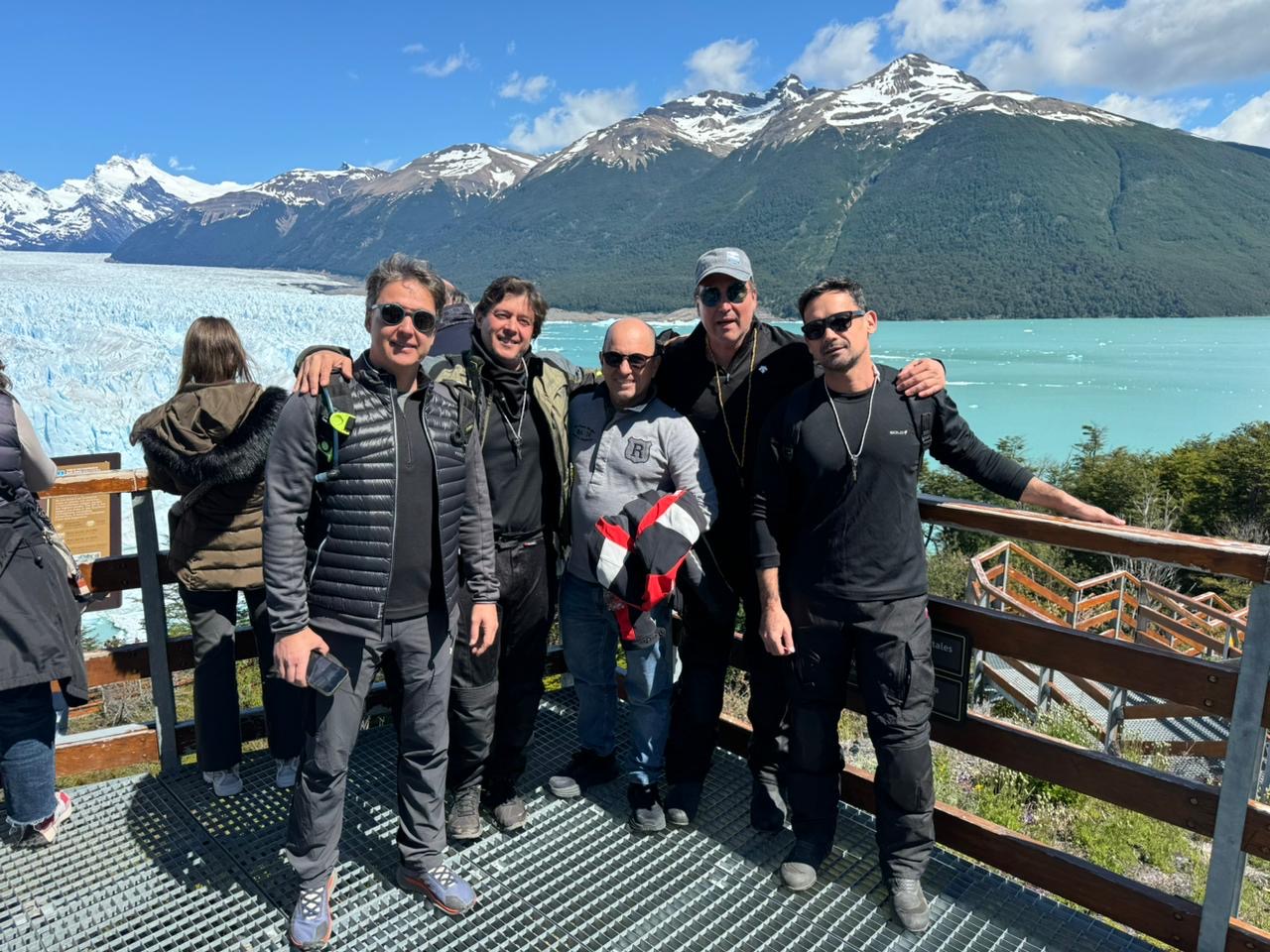
Patagonia needs no introduction. Any rider who has seen a photograph of a motorcycle parked in front of Fitz Roy, or on the shore of a glacial lake with snow-covered peaks behind it, has felt the immediate pull to be there. The real thing beats the photographs — because a photograph cannot capture the wind, the cold, the absolute silence and the feeling of standing in one of the last places on earth where nature still sets the rules.
It is also one of the most demanding motorcycle trips in South America. Gusts above 80 km/h, long stretches of loose gravel, huge distances between fuel stops and weather that turns in minutes. This guide covers what you need to settle before you book anything: which route, when to go, how many days, what it costs, which bike — and what actually changes about riding down there.
The three routes: Carretera Austral, Ruta 40 and Ushuaia
Patagonia breaks down into three main axes, each with its own character. Most well-built trips combine two of them — rarely all three in a single season.
Carretera Austral (Chile)
Chile’s legendary Ruta 7 runs roughly 1,240 km through cold rainforest, fjords, glaciers and turquoise rivers, from Puerto Montt down to Villa O’Higgins. It is the most scenic route and the wettest: it rains often, and a good share of it is still ripio — loose gravel. It pays back every kilometre in landscape, but it asks for constant attention.
One detail shapes the whole plan: the crossing between Villa O’Higgins and El Chaltén does not exist for motorcycles. It is a boat plus a hiking and cycling trail. Riders who do not know this end up in a dead end at the southern tip of the Carretera. That is why well-designed itineraries climb Argentina’s Ruta 40 and cross into Chile further north.
Ruta 40 (Argentina)
Argentina’s backbone: straight, windy and immense — about 5,000 km north to south, with Patagonia occupying the lower half. Less lush than the Carretera day to day, but it is the road that connects the icons: El Chaltén and Fitz Roy, El Calafate and the Perito Moreno glacier, and further north Bariloche and the Seven Lakes region. Here the real challenge is not the road surface, it is the crosswind.
Ushuaia and Tierra del Fuego
The end of the world. Reaching the southernmost point of the continent by motorcycle on Ruta 3 is a rite of passage. It involves a ferry across the Strait of Magellan at Primera Angostura and border crossings between Argentina and Chile, but the tarmac is good and the symbolic payoff is enormous. Technically the easiest leg, emotionally the strongest.
When to go: the window is November to March
The riding season in Patagonia is short and non-negotiable. Outside the Southern Hemisphere summer, snow and cold close mountain passes and turn gravel into a trap.
| Month | Weather | Wind | Daylight | Traffic |
|---|---|---|---|---|
| November | Unsettled, still cold | Moderate | ~15 h | Low |
| December | Stable, long days | Strong | up to 17 h | High |
| January | Warmest, stable | Very strong | ~16 h | Peak |
| February | Stable, cold nights | Strong | ~15 h | High |
| March | Unpredictable, autumn colours | Milder | ~13 h | Low |
December to February is peak season: the most reliable weather and the longest days, but also the fiercest wind and the busiest roads. November and March are the shoulders — fewer people, landscapes either still green or already turning, generally milder wind, in exchange for less predictable weather. June to August is out of the question on a motorcycle.
ROXMOTORS departures respect that window. Dates for each route are on the experience calendar.
How many days you need
- 7 to 8 days — one slice only: Ushuaia and southern Patagonia, or the El Calafate–El Chaltén–Torres del Paine core. A Fly & Ride format, with the bike waiting for you on arrival.
- 10 to 12 days — enough to combine two axes, typically Ruta 40 plus part of the Carretera, with one spare day for the weather to turn.
- 14 days — the full crossing: Punta Arenas to Puerto Varas, linear, with no backtracking. This is the format of the Patagonia and Carretera Austral expedition.
- 3 weeks or more — only if you plan to ride in from elsewhere on the continent rather than fly in.
The calculation most riders get wrong: keep at least one spare day per week. High wind, a cancelled ferry, a slow border and three days of rain are part of the route, not the exception.
What a Patagonia motorcycle trip costs
There is no single number, but there is a cost structure. Break it into parts and you can estimate your own scenario — and compare going alone with going on a supported expedition:
- Flights — into Punta Arenas, Ushuaia, El Calafate or Puerto Montt, usually connecting through Santiago or Buenos Aires.
- The bike — the most variable item: renting a big adventure bike in the region, or shipping and running your own.
- Fuel — distances are long and prices differ noticeably between Chile and Argentina.
- Accommodation and food — in high season, hotels and meals in El Chaltén, El Calafate or Torres del Paine cost well above the South American average.
- Travel insurance and assistance — effectively mandatory: the region is remote and evacuation is expensive.
- Extras — national park fees, ferries, tolls, border paperwork and excursions such as glacier navigation.
As a market reference, ROXMOTORS South America expeditions start at around USD 4,000 equivalent, with motorcycle, logistics and support included. The point is not which option is cheaper — it is that doing it alone trades money for time, planning and assumed risk.
Which motorcycle for Patagonia
Patagonia is adventure-bike country. The bike has to handle tarmac, gravel, wind and long distances with luggage. What matters:
- Range — a tank that comfortably covers 300 km. Some stretches of the Carretera and Ruta 40 have widely spaced fuel stops.
- Tyres — 50/50 or with genuine dirt performance. Pure road tyres on ripio are a recipe for surprises.
- Manageable weight — 1,200 cc adventure bikes are comfortable on the straights and punishing in soft gravel. Consider how you would pick it up alone.
- Protection — engine, hand and radiator guards. Flying stones are the norm, not the accident.
- Suspension travel — ripio is uneven by nature; short travel exhausts the rider long before it troubles the bike.
ROX expeditions run Triumph Tiger models, a balanced choice between road and dirt. If you want gravel confidence before you fly, that is exactly what the Off-Road Bigtrail training is for.
The wind: the part nobody prepares for
Everyone prepares for cold and gravel. Almost nobody prepares for wind — and wind is what defines your day on Ruta 40. Side gusts of 80 to 100 km/h are routine, and they arrive without warning the moment the road leaves a rock wall for open steppe.
- Loosen your grip. Stiff arms feed every gust straight into the steering; relaxed shoulders and elbows absorb it.
- Grip the tank with your legs and lower your centre of gravity. Support your body on the bike, not on your arms.
- Ride nearer the middle of the lane, never hugging the shoulder. You need room to be pushed sideways.
- Anticipate overtaking trucks: leaving the truck’s wind shadow throws the bike sideways. Commit and be ready.
- Slow down instead of fighting the wind. Wind fatigue accumulates — and a tired rider makes mistakes on gravel.
Ripio: riding on loose gravel
Ripio is the loose gravel that covers much of the Carretera Austral and several Argentine stretches. The rule is counter-intuitive: the bike settles with a little speed and steady throttle. Hard braking, closing the throttle mid-corner or forcing a steering correction is what puts riders down.
- Weight on the pegs, eyes far ahead, body relaxed. Let the front wheel work.
- Measured rear brake; front brake very sparingly.
- Watch the soft gravel that piles up in the centre of the road and along the edges.
- Lowering tyre pressure helps on long dirt sections — as long as you air back up for tarmac.
Borders, documents and insurance
The route crosses between Chile and Argentina several times, and each crossing has its own paperwork. The essentials:
- A valid passport, plus a visa if your nationality requires one for Chile or Argentina.
- Your home licence and an International Driving Permit — the IDP avoids arguments at checkpoints and rental desks.
- Vehicle documents and authorisation — a rented bike needs a cross-border authorisation from the rental company; request it well in advance.
- Mandatory local liability insurance — Chile requires SOAP, Argentina requires Mercosur cover.
- No animal or plant products in your luggage — Chilean agricultural inspection is strict and fines are high.
What to pack
A single day in Patagonia can bring sun, hail, 90 km/h wind and a wide temperature swing. The answer is layers, not bulk.
- Jacket and trousers with a genuine waterproof membrane, plus an over-suit for sustained rain.
- Thermal base layer (merino or synthetic), mid fleece, winter gloves and a spare dry pair.
- Balaclava and eye protection. Constant wind on your face is more tiring than you expect.
- Waterproof luggage, or dry bags inside your panniers.
- High-factor sunscreen: the ozone layer is thin here and the sun burns even in the cold.
On your own or with an expedition
Both are legitimate and suit different riders. On your own you gain complete freedom of pace and route, and you pay with months of planning, assumed logistical risk and the certainty that any breakdown on the Carretera is yours to solve. On an expedition you pay more and give up some improvisation, but you get a prepared bike, mechanical support, a support vehicle, accommodation secured in high season and someone who has already made the mistakes for you.
Frequently asked questions
Is riding in Patagonia dangerous?
It is not dangerous, it is demanding. The real risks are crosswind, loose gravel, long distances between help and fast-changing weather — all manageable with the right bike, a conservative pace and some dirt experience. Underestimating the region causes the problems, not the region itself.
Do I need off-road experience?
For the tarmac routes, such as Ushuaia and Tierra del Fuego, no. For the Carretera Austral, yes: there are long ripio sections where gravel confidence is the difference between enjoying it and suffering.
When is the best time to ride in Patagonia?
Between November and March. December to February brings the most stable weather and longest days; November and March are quieter with milder wind but less predictable conditions.
Can I ride two-up?
On the tarmac routes, yes, and it is common. On crossings with heavy ripio, such as the full Carretera Austral, it is not recommended — gravel with extra weight changes how the bike behaves and tires the rider much faster.
How many kilometres per day is reasonable?
Between 250 and 400 km on tarmac and 150 to 250 km on ripio. More is possible, but it turns the trip into a transfer — and Patagonia is precisely where stopping is worth more than advancing.
Ready to ride
Patagonia rewards riders who arrive prepared. If you would rather not build the entire logistics yourself, see the Patagonia Experience, the Ushuaia & Southern Patagonia expedition and the calendar — motorcycle, support and accommodation included, on dates that respect the November-to-March window.